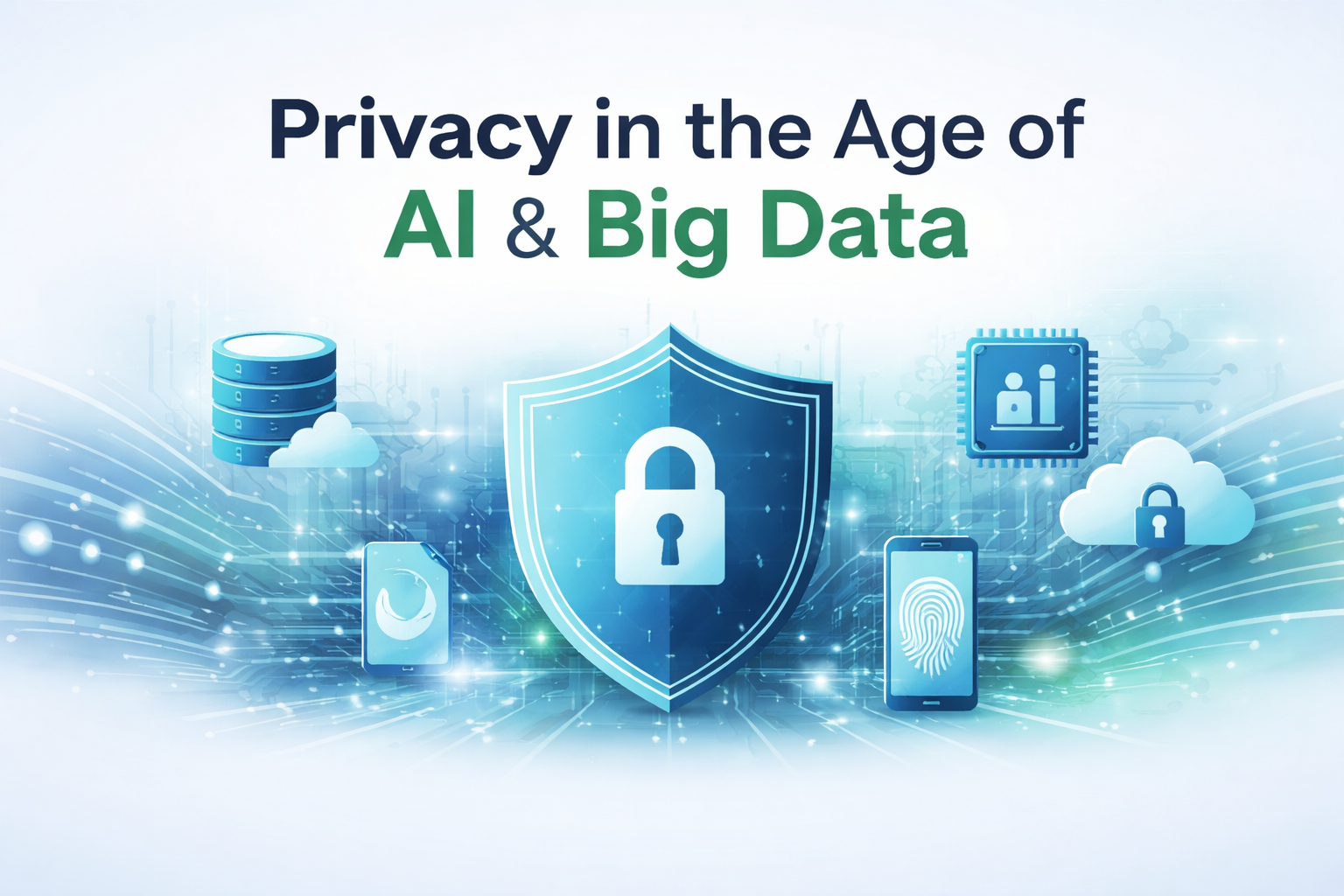
Privacy in the Age of AI and Big Data
Artificial Intelligence and Big Data are transforming how organizations operate. Businesses collect massive amounts of information to improve services, automate decisions, and gain competitive advantage.
But as data grows, so does privacy risk.
Understanding privacy in this environment requires looking at three things: what it is, how it becomes exposed, and how organizations can protect it.
What Is Privacy in the Age of AI?
Privacy today goes beyond protecting names and email addresses.
AI systems analyze behavior, patterns, preferences, and even predict future actions. Big data platforms combine information from multiple sources to generate insights.
This means privacy now includes:
- Personal data stored in databases
- Behavioral data collected through apps and devices
- Inferred insights generated by AI models
- Predictive profiles built from analytics
In simple terms, privacy in AI is about protecting both the raw data and the intelligence created from it.
How Privacy Gets Exposed
In AI and big data environments, privacy risks usually come from cybersecurity weaknesses.
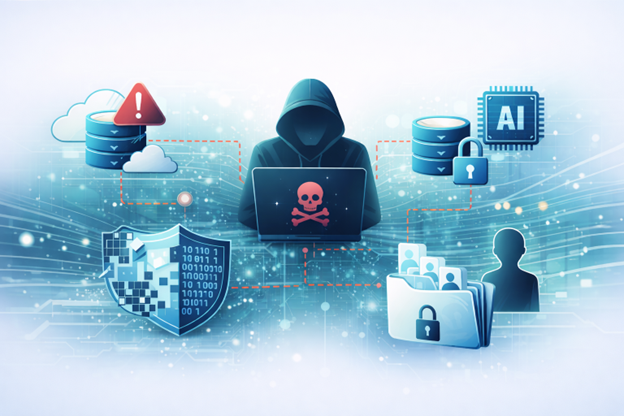
Common exposure points include weak access controls that allow unauthorized users to access datasets, cloud misconfigurations that expose storage buckets or databases, compromised credentials that give attackers entry into analytics platforms, insecure APIs that allow data extraction, and poorly protected AI models that leak sensitive training information.
Data over-collection also increases exposure. When organizations store more information than necessary, the impact of any breach becomes much larger.
When attackers gain access, they do not just steal files. They may access behavioral insights, risk scores, and predictive analytics that reveal deeper personal information.
That makes AI-driven environments high-value targets.
How Organizations Can Stay Protected
Protecting privacy in AI environments requires practical cybersecurity measures. Organizations should focus on:
1️⃣ Limit Data Collection
Collect only what is necessary and clearly define the purpose of each dataset before it is used in analytics or AI training.
2️⃣ Enforce Strong Identity & Access Controls
Apply least-privilege access, continuously monitor privileged accounts, and restrict access to sensitive datasets and AI models.
3️⃣ Secure Cloud Infrastructure
Ensure proper configuration, encrypt data at rest and in transit, and conduct regular security audits of storage and computing environments.
4️⃣ Protect AI Development Pipelines
Validate training data integrity, restrict model repository access, and monitor for abnormal model usage or query behavior.
5️⃣ Implement Continuous Monitoring
Detect unusual data access, abnormal exports, suspicious API activity, or unexpected cross-environment data movement early.
At 𝗶𝟲, privacy protection in AI and big data environments is treated as a cybersecurity engineering discipline. 𝗶𝟲 secures data architecture, strengthens identity governance, protects AI pipelines, and embeds continuous monitoring into operations — integrating protection directly into infrastructure rather than reacting after an incident.
Final Thoughts
AI and Big Data create powerful opportunities for innovation. But they also expand exposure.
Privacy today is not just about compliance. It is about securing data, algorithms, and digital trust.
With structured governance and strong cybersecurity controls — like the approach implemented at 𝗶𝟲 — organizations can innovate confidently without compromising the individuals behind the data.