

QR codes have quickly become part of everyday life. From restaurant menus and parking payments to login portals and document sharing, scanning a code is now second nature.
But this convenience has created a new attack surface. Cybercriminals are increasingly using QR codes as a delivery mechanism for phishing—commonly referred to as quishing. Unlike traditional phishing, where users can inspect links or emails, QR code attacks hide the destination completely until after the scan.
This makes them more deceptive, harder to detect, and increasingly effective.
What Makes QR Code Phishing Different xt Here
QR code phishing attacks are simple in execution but powerful in impact. Attackers embed malicious URLs into QR codes and distribute them through both digital and physical channels.
A typical attack unfolds like this:
- The attacker creates a QR code linked to a malicious site
- The code is placed in emails, posters, websites, or public locations
- A user scans the code, expecting a legitimate action
- The user is redirected to a fake login, payment page, or download
- Sensitive data is captured or malware is delivered
Because the process feels normal and frictionless, users rarely question it.
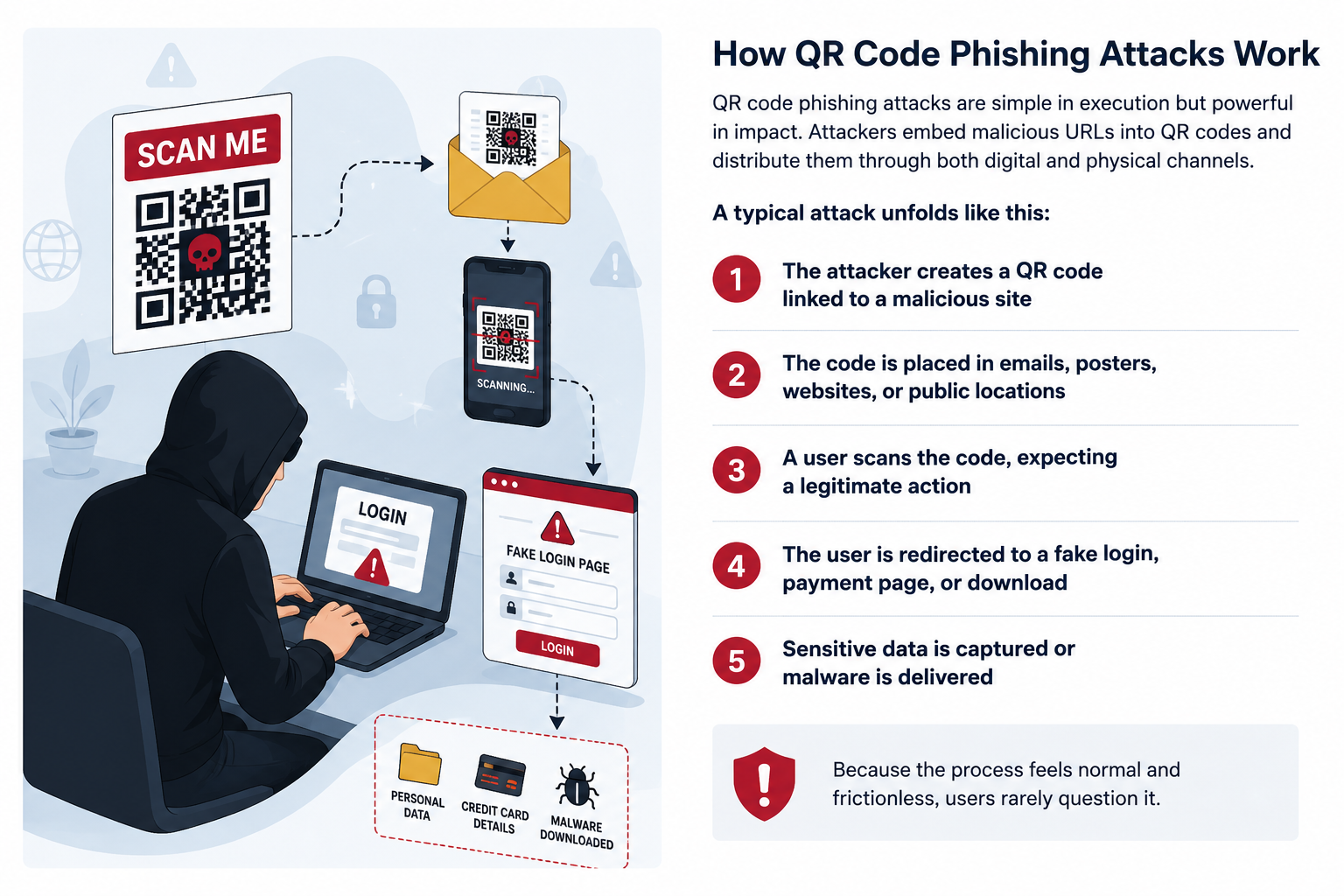
How QR Code Phishing Attacks Work
QR code phishing attacks are simple in execution but powerful in impact. Attackers embed malicious URLs into QR codes and distribute them through both digital and physical channels.
A typical attack unfolds like this:
- The attacker creates a QR code linked to a malicious site
- The code is placed in emails, posters, websites, or public locations
- A user scans the code, expecting a legitimate action
- The user is redirected to a fake login, payment page, or download
- Sensitive data is captured or malware is delivered
Because the process feels normal and frictionless, users rarely question it.
Where These Attacks Are Happening
QR code phishing is not limited to one channel—it is spreading across multiple environments.
In corporate settings, attackers embed QR codes in phishing emails, asking users to scan them for account verification or secure document access. This helps bypass email security filters that typically scan links.
In public spaces, attackers replace legitimate QR codes with malicious ones. For example, a QR code on a parking meter or restaurant table can be swapped with a fake version that redirects to a fraudulent payment page.
Even digital platforms are being used, where QR codes are shared through messaging apps or social media, often disguised as promotions or urgent updates.
Why QR Code Phishing Is So Effective
The success of QR code phishing lies in its ability to exploit both technology and human behavior.
First, it removes visibility. Users cannot easily inspect the destination before interacting.
Second, it leverages trust. QR codes are widely associated with convenience and legitimate use cases.
Third, it shifts the attack to mobile devices, where traditional endpoint protections and monitoring are weaker compared to desktops.
Finally, it introduces urgency and familiarity. Messages often encourage quick action, reducing the likelihood of careful verification.
Real-World Scenario
Consider an employee receiving an email from what appears to be IT support. The message states that their account needs verification and includes a QR code for quick access.
The employee scans the code using their phone and is redirected to a login page that looks identical to the company portal. Without hesitation, they enter their credentials.
At that moment, the attacker captures the login details. Since the action occurred on a personal device, it may not trigger corporate security alerts immediately.
The attacker can now access internal systems using legitimate credentials, making the breach even harder to detect.
The Risks and Impact
QR code phishing can lead to a wide range of security incidents. Once the user interacts with the malicious destination, attackers can:
- Steal login credentials and gain unauthorized access
- Capture financial or payment information
- Install malicious applications on mobile devices
- Launch further attacks using compromised accounts
Because these attacks often bypass traditional defenses, they can escalate quickly and spread within an organization.
How Organizations and Users Can Respond
Defending against QR code phishing requires awareness and control across both digital and physical environments.
Organizations need to treat QR codes as potential attack vectors, not just convenience tools. This includes monitoring how they are used in communications and ensuring that employees understand the risks.
Users, on the other hand, should adopt a more cautious approach. Scanning a QR code should be treated the same as clicking an unknown link.
Before interacting, users should verify the source, check the URL preview if available, and avoid entering sensitive information on unfamiliar pages.
How 𝗶𝟲 Helps
At 𝗶𝟲, we focus on identifying modern attack vectors that often bypass traditional controls, including QR code-based threats.
𝗶𝟲 enables organizations to monitor user behavior across endpoints and detect suspicious activity originating from mobile and web interactions. By providing visibility into unusual access patterns and potential credential misuse, organizations can respond quickly even when the initial attack vector goes unnoticed.
Our approach ensures that threats like QR code phishing are not just prevented, but also detected early—before they can escalate into larger breaches.
Final Thoughts
QR code phishing highlights how cyber threats continue to evolve alongside everyday technology. What was once a simple convenience tool has now become a powerful attack vector.
As attackers adapt, so must security strategies. Awareness, visibility, and verification are critical in reducing risk.
In today’s landscape, even something as simple as a scan should not be taken at face value.